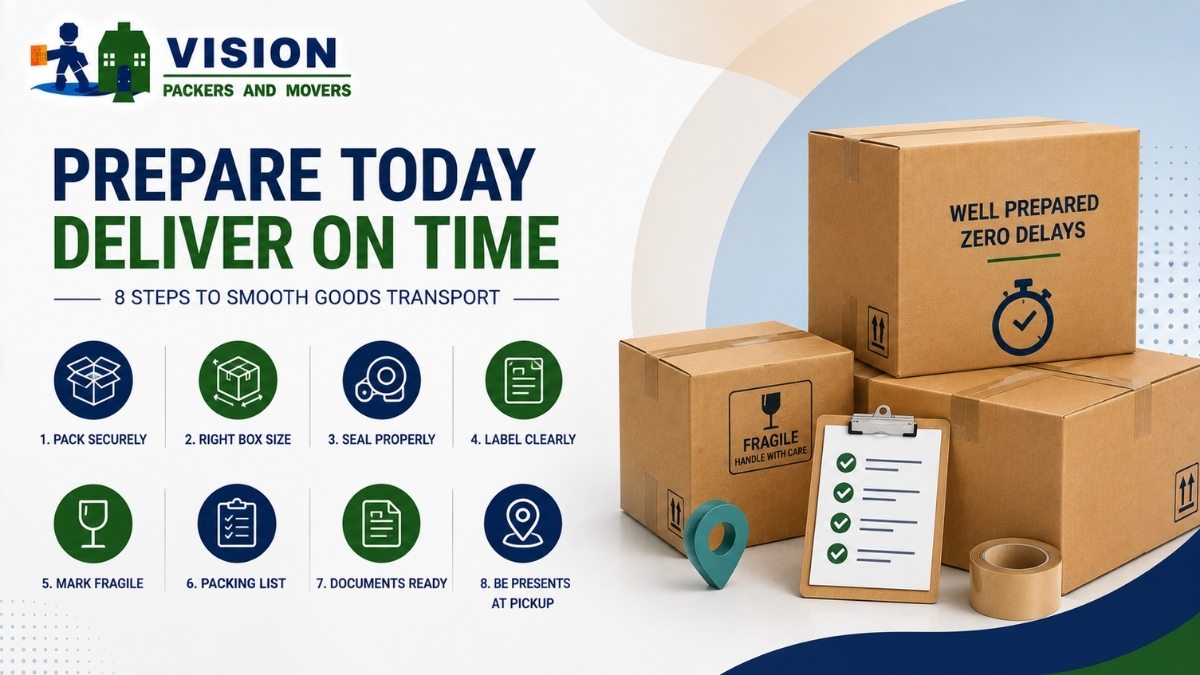
Most goods transport delays happen before the vehicle even starts moving. A pickup team that arrives to find loose, unsealed, or unlabelled goods has to spend additional time on-site handling problems that could have been resolved in advance. Preparation at the sender end is entirely within your control — and it is the most effective way to prevent delays from the very start of the journey.
Step 1: Pack Every Item Securely Before the Pickup Team Arrives
Every item should be fully packed, sealed, and ready to load when the pickup team arrives at your door. Loose items or goods that have not been packed when the team arrives require on-site improvisation that takes extra time and is never as secure as proper pre-move packing. Finish all packing the evening before the scheduled pickup so the morning of the move is spent loading, not scrambling for boxes and tape.
Step 2: Use the Right Box Size
Overfilled boxes burst at the seams under the weight of other items stacked on top during loading. Underfilled boxes collapse inward and can damage the contents. Use a box size that allows you to fill it close to the top without forcing the lid down. Fill any gaps inside the box with crumpled newspaper, bubble wrap, or foam packing peanuts so the contents are held firmly and cannot shift when the box is moved or stacked.
Step 3: Seal Every Box Completely
Run strong packing tape along all four seams on the top of every box, and reinforce the base seams of heavier boxes with an additional strip. A box that opens during transit causes a delay because the contents must be repacked — usually without proper materials available at a transit depot. A properly sealed box takes thirty seconds to prepare and prevents a problem that could add hours to the delivery timeline.
Step 4: Label Every Box Clearly on the Outside
Write the destination address and a brief description of the contents on the outside of every box, in large clear text that can be read quickly. Labels prevent sorting errors at the depot, speed up the loading process at the pickup point, and make verification of the complete consignment at the delivery end much faster. Use a permanent marker and write on at least two sides of each box so the label is visible regardless of how the box is oriented during storage or loading.
Step 5: Mark Fragile Items Clearly on All Sides
Write "Fragile" or "Handle with Care" in large letters on all four sides and the top of every box that contains breakable contents. The loading team uses these markings to decide where to place each box in the vehicle — fragile boxes go on top of the load, not at the base where they will carry the weight of everything above them. An unmarked box that contains glassware or ceramics is very likely to be placed incorrectly during a busy loading operation.
Step 6: Prepare a Packing List
Write a simple list of every box in the consignment with a brief description of the contents of each one. Keep a copy for yourself and give a copy to the pickup team when they arrive. This list serves two purposes: it allows the receiving end to verify that every box has arrived, and it speeds up the process of filing a missing item report if anything is found to be absent at delivery. A packing list takes ten minutes to prepare and prevents significant uncertainty at the delivery end.
Step 7: Have All Documents Ready
For intercity or commercial goods transport, the sender may need to provide an invoice, an e-way bill, or a delivery address proof before the pickup team can accept the consignment for transport. Missing documents are one of the most common causes of delays at the pickup stage. Confirm with the transport company the day before pickup which documents are required and have them printed or saved on your phone before the team arrives.
Step 8: Be Present at the Pickup Location
Someone must be available at the pickup address for the full duration of the loading process. Last-minute changes to the pickup location, a contact person who cannot be reached, or an address that turns out to be different from what was booked all cause delays that could have been avoided entirely. Confirm the pickup time with the transport company the day before, and stay reachable on the same phone number you provided at the time of booking.
Following these eight steps takes thirty to sixty minutes of preparation but can prevent delays of a day or more on the receiving end. The effort is concentrated at the beginning of the journey, where it has the greatest impact on everything that follows.