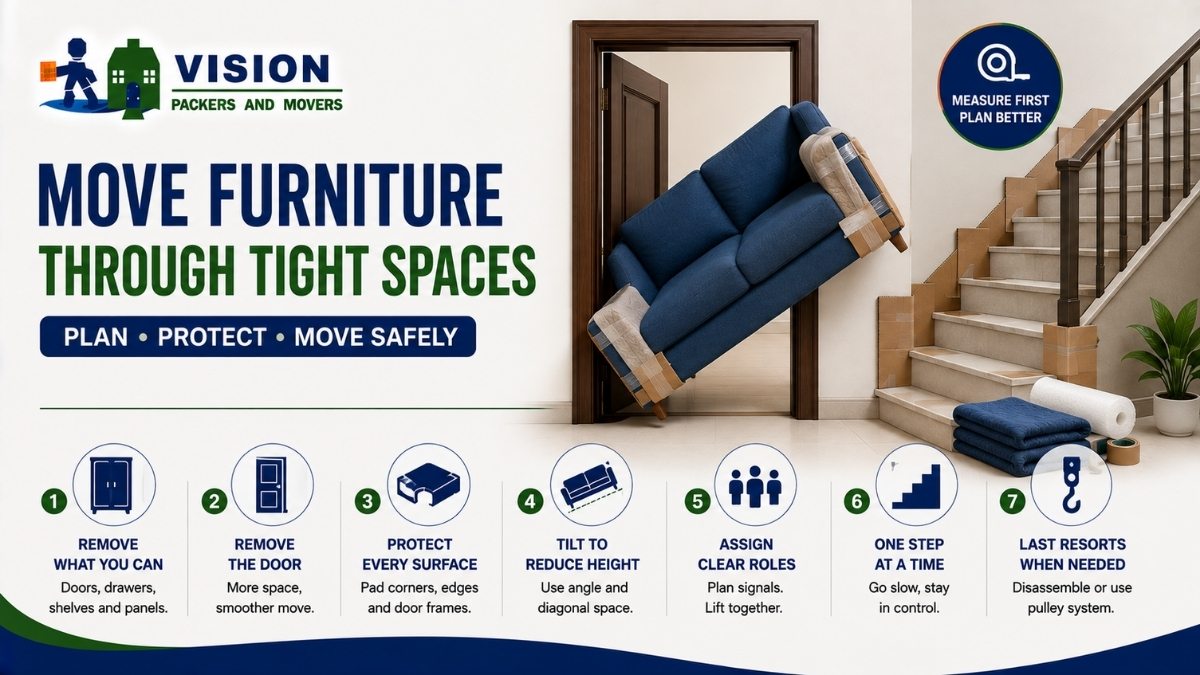
Tight doorways and narrow staircases are where many house shifts encounter their first serious problems. A sofa that arrived through the front door years ago suddenly seems impossible to remove. A wardrobe that stood perfectly in the bedroom cannot be carried down the staircase without a clear plan and the right approach. Taking the right steps before any lifting begins protects your furniture, your walls, and everyone involved in the move.
- Measure the height, width, and depth of the furniture piece you plan to move
- Measure the doorway width and the clearance height at the top of the frame
- Check the staircase width and note any tight corners, low ceilings, or landing restrictions along the full route
Step 1: Remove Doors, Drawers, Shelves, and Removable Panels
Before anything is lifted, strip the furniture of every component that can be detached. Doors, drawers, shelving inserts, glass panels, and detachable legs all add weight and width to the piece. Removing them reduces the effective size, makes the piece lighter, and eliminates the risk of loose parts swinging open mid-carry and causing damage to walls or injury to helpers. Tape all small fixings such as screws and hinge pins directly to the piece they belong to so nothing is misplaced during the move.
Step 2: Remove the Room Door From Its Hinges If Needed
A standard interior door in India adds several centimetres of obstruction to the doorway opening. Removing the door from its hinges is a straightforward task that takes two minutes with the right screwdriver and can add four to six centimetres of extra clearance — sometimes enough to make the difference for a large wardrobe or wide sofa. Replace the door once the furniture has passed through and the path is clear again.
Step 3: Protect Furniture Corners and Door Frames With Padding
Wrap the corners and edges of the furniture piece in bubble wrap or foam padding and secure with tape before any movement begins. Attach moving blankets or strips of corrugated cardboard to the door frame and along the staircase walls at every point on the route where the furniture is likely to make contact. This layer of protection prevents scratches and impact damage to both the furniture and the structure of the home during the carry.
Step 4: Tilt the Piece to Reduce Its Effective Height
A piece of furniture that appears too tall for a doorway opening can often pass through when tilted at an angle — this technique is sometimes called the diagonal trick. A wardrobe that is 200 cm tall and 60 cm deep has a diagonal measurement of approximately 209 cm. However, when tilted to a carrying angle, its effective profile through the doorway is reduced. One helper tilts from the top while another supports the base. Calculate the diagonal dimension before concluding that a piece cannot pass — the mathematics often reveals more clearance than the eye suggests at first glance.
Step 5: Assign Roles Before Lifting
Before the furniture leaves the ground, every person involved in the move must know exactly what they are doing. You need at least three people for a large piece — one at each end and one guiding from the other side of the tight space to direct movement through the gap. Agree on clear spoken signals before you begin: a word for lift, a word for stop, a word for lower. Confusion when arms are full and a heavy piece is mid-carry through a narrow doorway leads to drops, wall damage, and potential injuries to everyone involved.
Step 6: Move One Step at a Time on Staircases
On a staircase, advance exactly one step at a time and stop to assess at every landing or change of direction. The person at the lower end carries more of the weight when descending a flight — rotate positions between helpers if the load feels uneven after a full flight of stairs. Never rush on a staircase under any circumstances. If the furniture begins to tip or feels uncontrolled at any point, lower it immediately to the nearest step, reposition the team, and restart the descent with everyone in full control before continuing.
Step 7: Know When to Stop — Two Last-Resort Options
If all practical techniques have been attempted without success, two final options remain available. The first is full disassembly of the furniture. Many wardrobes, bed frames, dining tables, and bookshelves can be taken apart completely with basic household tools. This takes additional time but is often the safest and most practical solution for a piece that simply will not clear the available route. The second option — more common than most people realise, particularly in older Indian apartment buildings with narrow internal staircases — is to remove a window frame and use a rope and pulley system to lower or raise the piece through the window opening. Professional movers carry the equipment for this and treat it as a standard technique when the internal route is completely blocked.
Professional movers assess and handle tight spaces regularly as part of their normal work. If you are uncertain about whether a piece can be moved safely through your building, ask the moving team to inspect the route before any lifting begins rather than attempting a difficult and potentially damaging move on your own.